Some of you have noticed the sharp decline in posts over the past year. I've scarcely managed to put out anything. Why is that, you wonder?
Let's take a stop in at the Cheerios Garden and find out.
Rewind back to December 2007. I did that whole birthing thing on the last day of the year. A week later, my darling husband went back to school to work on finishing his Bachelors degree. He worked full time and took 1 or 2 classes every semester until May of 2010. It was difficult, but we managed it. We thought we had it hard then.
Over the summer of 2010, Andrew (that's DH) attempted to job hunt and interviewed all over the country. We had no idea what we were going to be doing in a few months. We had an upstairs neighboring family that repeatedly came home late at night and allowed their young children to use the Wii Fit at insane hours. We traveled to Georgia with our child for several days. And after enjoying all that stress in his first semester off in 2 and a half years, Andrew came down with shingles, hardcore, and spent the worse part of a month in painful agony.
What does that have to do with my blogging? Well, I kept up okayish during that time. I made some posts as I could, despite spending a good deal of my time picking up the parenting/household maintenance slack and being in chronic pain (n.b. I had been suffering from a spinal injury to my neck from December 2006 still).
And then in the fall of 2010, Andrew started graduate school. He disappeared even more from our lives. Shortly thereafter, my pain level had finally subsided, miraculously, after nearly 4 years of chronic pain. I actually had some days each week in which I felt human again. (That's also gone again; I was rear-ended again this May, with new injuries, and I'm still in physical therapy twice a week.)
And a couple of weeks later, Jackson stopped napping.
Guess which had the most effect on my blogging?
He was about 2 months shy of his 3rd birthday, and Jackson went from napping 3 hours a day while I rested and blogged, to zilch. To make matters worse, he sometimes would really need a nap, and I would let him take one.... If I woke him after a short nap, he turned into a gremlin. If I let him sleep a full 2 and a half or 3 hours, he woke refreshed and didn't feel the least bit tired until some time after midnight--at which point, I started turning into a gremlin.
This cycle continued for a few months. MONTHS. Do you understand how long that is? We went from a predictable, easy, daily schedule that was naturally maintained and preserved as sacred to this horrid cycle of unpredictability. There was no winning. No matter what we did, someone was going to lose, and it was usually all of us.
But mostly, and this may be me being egocentric, I feel like I was the one who lost. I lost my time to myself. I lost peace and healing rest. I lost my blogging hours. Right now, I'm trying to write this with Andrew sitting next to me, and I had to ask him to STFU and not interrupt. But I feel like a jerk because this is nearly 10pm on a Friday. It should be OUR time.
But it's never my time anymore. Ever.
I didn't realize just how little "me" time I'd been getting until about a month ago. I was scheduled to go for a moms' night out (MNO) with some other mom friends. And much as I love their company and our little infrequent gatherings (usually about 3x per year at most), there was this selfish little homonculus talking in my head, saying, "Don't go. Just find a quiet place to sit and do nothing. You'll love it!"
Well, I did go, and I really did have a great time. But what about me? Well, I took the advice of that homonculus, finally.
Last week, we went to a pumpkin patch as a family. It's a fairly lame one, so I'm told, but it has a bounce house and a hay wagon pulled by a tractor, which is plenty enough for Jackson to be content. The pumpkin patch, such as it is, gets held by the church on whose grounds it occupies each year. This was our 3rd year attending and the first time I'd noticed a "Meditation Walk" sign at the edge of a woody area.
I informed Andrew that my phone was left at home and that he was going to be on duty while our spawn enjoyed shaking his brains in the bounce house. And I went to explore this Meditation Walk place.
I was expecting more of a walk in terms of distance, but what I got was much better. There was a stream that was partially underground, partially exposed. There were dead tree branches suspended in midair by their living compatriots. There were enormous Tarzan-swing-able vines hanging ubiquitously. And I was all by myself. It was delicious.
I had no clock, watch, cell phone, computer, or anything of the sort. I sat and thought about my life. I thought about things that were making me happy. I thought about things that were stressing my brain. I thought about things I wanted to change or to be able to change. I allowed myself not to worry about my son. I allowed myself not to worry about my husband. For a brief span, it was just about me and how I felt.
Then I heard my name being shouted irritably, "Jessica!" I got up and brushed off the dirt and dragged myself back out of such a glorious place.
I'd had my 45 minutes. It was time to go back to the Real World.
I hadn't really resolved anything other than that I need more time to just breathe and be me. We have 14 more months until Andrew finishes his masters degree. I have forbidden him to even consider a doctoral program. Jackson will be nearly 5 when Andrew gets this degree, having known his father as a perpetual student and part-time figure in his life, his entire life.
What will I do when I no longer have to be a parent and three quarters? Will I write more? Will I meditate? Will I learn French (which I've been putting off)? Will I learn guitar? Will anything change?
I'll have to see where I am in another 14 months. Until then, I'm sorry for the limited posts. I know some of you have depended on me to demonstrate the grossness and absurdness of parenting. Some of you have even told me how helpful I've been by writing this blog. You guys are awesome. Seriously.
So please, baby, understand, it's not you, it's me. It's just that I've got this thing in my life right now, and all, and it's not that I don't love you, baby. It's not that at all. And if it really bothers you...come babysit my kid so I can get some writing time! <3
Friday, October 21, 2011


Wednesday, July 27, 2011
The Girl Effect
This is a blog post that I wrote back in October of 2010, and for some reason, I never posted it to the blog! Here it is, in all its delayed glory!
I spent a huge portion of my life involved in Girl Scouts USA. For those of you not in the United States, this is the same group as Girl Guides. Growing up, we learned a lot of delightful things about how to be empowered women. We learned about leadership and different skillsets that we could pursue. We learned self-sufficiency and a whole host of wonderful ways to be a positive influence in the world.
Yet, after watching the videos at The Girl Effect, I am forced to recognize that not everyone had that kind of background. Starting today, this page will be sporting the banner ad for The Girl Effect. Their message is simple: empower young women, and the whole world will benefit.
The simplicity of it makes it feasible. There are so many humanitarian efforts out there that overcomplicate the issue of how to help others. Even those who seemingly know that it's better to "teach a man to fish" rather than to just "feed him for a day", these same folks still often get it wrong. How can we help?
As armchair philanthropists, many people feel the simplest way they can help is to write a check or swipe a credit card. We don't all want to go to Bangladesh and get involved on a personal level. And what this site is telling us is that we don't have to do that at all. What needs to happen, they claim, is that we need to foster a situation in which teenage girls are encouraged to stay in school until at least 18 years of age.
There are myriad ways of making something like this happen. Funding a school, providing school uniforms for students who can't attend because of an apparel requirement, micro-lending, etc. These are just some random ideas off the top of my head. And if you don't feel like going it alone, get a group together of people who feel that the women of the world are a worthy cause and pool your efforts. It doesn't have to be anything formal.
Go watch the videos on the title link above (if you haven't already) and come back here.
Done yet?
Okay.
I'm going to make it easy for you to help others. My blog is really about helping parents to raise their children in the best fashion they possibly can manage. Parenting doesn't stop at your own children. And who knows? Maybe by helping children in other parts of the world, you'll have a net positive effect on your own child. It could very well be that you manage to empower and inspire a young girl to grow to be a future world leader that does many great and wonderful things to improve the world. And in the process, you can tell your child(ren) about the idea so that they can think globally as well. And you can tell your friends, so that maybe they will be interested in being proactive as well. And pretty soon, all those little efforts build up to great efforts with great effects.
How can you start?
Micro-lending is a fairly new phenomenon. It helps people worldwide to afford to start small businesses. Rather than just throwing money at a problem, you instead invest in someone who, in return, pays you back with interest. Here are some places that do micro-lending:
NOTE: I am in no way affiliated with these sites, nor have I personal experience in these particular ones. They were what came up in a Google search.
Kiva: http://www.kiva.org/ "We are a non-profit organization with a mission to connect people through lending to alleviate poverty. Leveraging the internet and a worldwide network of microfinance institutions, Kiva lets individuals lend as little as $25 to help create opportunity around the world."
Accion: http://www.accion.org/ "Accion's mission is to give people the financial tools they need--microloans, business training, and other financial services--to work their way out of poverty."
Prosper: http://www.prosper.com/ "We want to connect people who want to invest money with people who want to borrow money."
And because I've focused on The Girl Effect, here are a couple other great links:
Women for Women: http://www.womenforwomen.org/index.php "Helping women survivors of war rebuild their lives."
Center for Effective Philanthropy: http://www.effectivephilanthropy.org/index.php "The Center for Effective Philanthropy (CEP) provides foundations and other philanthropic funders with comparative data to enable higher performance." [Disclosure: I have a friend who works at this company, and she LOVES her job. What a great idea for a business!]
_________________________________________________
I spent a huge portion of my life involved in Girl Scouts USA. For those of you not in the United States, this is the same group as Girl Guides. Growing up, we learned a lot of delightful things about how to be empowered women. We learned about leadership and different skillsets that we could pursue. We learned self-sufficiency and a whole host of wonderful ways to be a positive influence in the world.
Yet, after watching the videos at The Girl Effect, I am forced to recognize that not everyone had that kind of background. Starting today, this page will be sporting the banner ad for The Girl Effect. Their message is simple: empower young women, and the whole world will benefit.
The simplicity of it makes it feasible. There are so many humanitarian efforts out there that overcomplicate the issue of how to help others. Even those who seemingly know that it's better to "teach a man to fish" rather than to just "feed him for a day", these same folks still often get it wrong. How can we help?
As armchair philanthropists, many people feel the simplest way they can help is to write a check or swipe a credit card. We don't all want to go to Bangladesh and get involved on a personal level. And what this site is telling us is that we don't have to do that at all. What needs to happen, they claim, is that we need to foster a situation in which teenage girls are encouraged to stay in school until at least 18 years of age.
There are myriad ways of making something like this happen. Funding a school, providing school uniforms for students who can't attend because of an apparel requirement, micro-lending, etc. These are just some random ideas off the top of my head. And if you don't feel like going it alone, get a group together of people who feel that the women of the world are a worthy cause and pool your efforts. It doesn't have to be anything formal.
Go watch the videos on the title link above (if you haven't already) and come back here.
Done yet?
Okay.
I'm going to make it easy for you to help others. My blog is really about helping parents to raise their children in the best fashion they possibly can manage. Parenting doesn't stop at your own children. And who knows? Maybe by helping children in other parts of the world, you'll have a net positive effect on your own child. It could very well be that you manage to empower and inspire a young girl to grow to be a future world leader that does many great and wonderful things to improve the world. And in the process, you can tell your child(ren) about the idea so that they can think globally as well. And you can tell your friends, so that maybe they will be interested in being proactive as well. And pretty soon, all those little efforts build up to great efforts with great effects.
How can you start?
Micro-lending is a fairly new phenomenon. It helps people worldwide to afford to start small businesses. Rather than just throwing money at a problem, you instead invest in someone who, in return, pays you back with interest. Here are some places that do micro-lending:
NOTE: I am in no way affiliated with these sites, nor have I personal experience in these particular ones. They were what came up in a Google search.
Kiva: http://www.kiva.org/ "We are a non-profit organization with a mission to connect people through lending to alleviate poverty. Leveraging the internet and a worldwide network of microfinance institutions, Kiva lets individuals lend as little as $25 to help create opportunity around the world."
Accion: http://www.accion.org/ "Accion's mission is to give people the financial tools they need--microloans, business training, and other financial services--to work their way out of poverty."
Prosper: http://www.prosper.com/ "We want to connect people who want to invest money with people who want to borrow money."
And because I've focused on The Girl Effect, here are a couple other great links:
Women for Women: http://www.womenforwomen.org/index.php "Helping women survivors of war rebuild their lives."
Center for Effective Philanthropy: http://www.effectivephilanthropy.org/index.php "The Center for Effective Philanthropy (CEP) provides foundations and other philanthropic funders with comparative data to enable higher performance." [Disclosure: I have a friend who works at this company, and she LOVES her job. What a great idea for a business!]
_______________________________________________
So, apparently I hadn't posted this last October because I didn't have the links, so now they are there. Enjoy!
Tuesday, July 12, 2011
Truthiness
I've just had several encounters with a youthful personage (not my own spawn) that have got me thinking on the subject of honesty. So, given that it's on the brain, here goes.
I'm a big advocate of honesty being the best policy. Sure, sometimes, there are situations in which it is best not to reveal the whole extent of the truth (i.e. telling young children how long they will be stuck in a car on a road trip; telling a squeamish child the intricacies of how their sausage was made; revealing too far in advance details of plans for something really fun that have a very real chance of getting canceled, etc.).
Then there are times when it is inappropriate. Unfortunately, adults have a bad habit of teaching children to lie. We do it from a very early time in a child's life, and unless a great deal of care is taken, kids will perpetuate this handy trick and expand upon it significantly, refining and polishing skills at falsehood until fibbing becomes a well-practiced art.
How do adults do this? Well, Po Bronson and Ashley Merryman actually discuss this is their book, NurtureShock. You can read their findings on the subject here.
And I quote:
Let me ask you (as one perhaps ought not to ask a child):
Do you ever ask a child things like: Did you take Ava's toy? Did you hit Jeremy? Did you draw all over the wall with crayons? Especially when you know darn well the child did in fact do those things?
How about this: If the child says yes to any of those questions, do you get angry? Do you yell? Is there a punishment?
Riddle me this, Batman: What incentive is there for the child to admit to doing wrong? What benefit does she gain by this questioning process? She's more likely to lose by it. Every time. Eventually, some fragile little part of one's precious little snowflake snaps, and the untruthful homunculus saunters out and spreads the seeds of dishonesty.
Bronson and Merryman claim that the studies they read indicated lying to be a measure of intelligence, in very young children.
So, is it a good thing that we teach our children to lie to us? Should I be pleased that my not-quite-3-and-a-half year old son is getting quite adept at making up stories? [A recent favorite: "My grandfather is fierce! He used to make toothbrushes!" I suspect this one was related to a dream, as it came just after he woke from a reverie.] I want to encourage him to write stories of his own, but then am I encouraging him to blur the boundary between truth and fiction?
On the other hand, one of the books on my Amazon Wish List is Already Ready: Nurturing Writers in Preschool and Kindergarten. Up until now, my thoughts regarding the suggestions of the authors revolved around whether or not the activity would impede or improve my son's progress toward learning and loving to read and write. The authors assert that children should write books and draw pictures associated with the "words", even before they know how to read and write or even know their letters. This is a similar notion to one in the Tools of the Mind classrooms, which assert that even such young children who scribble fake writing will remember what they "wrote" and can "read" it back to others. By using such methods, am I helping or hurting my child's honesty skills?
Having read NurtureShock when my son was very young, I made early attempts to curb behaviors of my own and my husband's that I thought would contribute to the development of untruthfulness. Truth has been a big issue with me for most of my life. I'm not perfect, though: I still fib often enough. But I try to avoid an outright lie as much as possible. When I see a friend's child whom I am expected to praise, and to my own eyes, the child isn't anything my eyeballs care to focus on, I will not exclaim over how insane beautiful said child is. I've seen people make absurdly effusive comments on the issue of beautiful babies when there is clearly no such element to the baby in question. Sure, it's better than saying, "Hey, um, are you sure you put the right end of the kid in the diaper?" But isn't it also possible to make comments other than on the beauty (or lack thereof) of a child? How about how sweet, adorable, happy, cheerful, fun, playful, calm, rambunctious, fiesty, gentle, bright-eyed, quick, observant, mobile, strong, or clever the child is?
Bronson and Merryman talk about these kinds of white lies as a way in which parents encourage their children to lie. Parents look on their efforts as teaching children to be polite. But aren't they really teaching insincerity? How about instead, we teach children to find the silver lining? Or to tactfully tell the truth?
I am reminded of a rant I wrote several years ago (April 2003) in a vent of frustration about Being Nice:
I read a lot of pre-20th Century fiction, and the word nice as it was used then is different from how it is used now. Niceness has changed in meaning a great deal over time. Women were "nice" with their apparel being arranged just-so. Manners were "nice," and "disaffected" and "disinterestedness" were good things.
So, if one avoids being "nice" and aims to reduce punishments that reward the parents with dishonest children, what kinds of consequences result?
Consider what it means for a child to argue: one, we already know the child is being open with the parent. There is a certain level of trust there. Two, teens are developing their reasoning skills. To argue with a parent or another adult is to practice this newly developed surge in logical deduction. Three, children of all ages learn by testing their boundaries. Does no always mean no? How about when your back is turned?
If the child is arguing about a rule or a decision, it really is a sign of respect that should not be ignored. Some parents get this far and then mess it up by throwing out an ultimatum like "Because I said so." Some others prefer to wade in vagueries and hope the child gives up the pursuit. This is not helping the child to understand the reasoning the parent is using, so if the teenager cannot comprehend a sufficient reason to follow the rule or decision, he is far more likely to do what he wants anyway and try not to get caught.
From what I've read by those who have really studied the matters of parenting and child development, it seems like honesty with your children is the best policy. But only so much as they need. (For example, when your 5 year old child asks about things like sex, only answer the questions that are asked, and answer them honestly and briefly. No bees, flowers, gardens, or other confusing metaphors.) Ultimatums and waffles do not help develop your teenager's burgeoning rationality but rather fight against it. A child is much better protected against vice when she understands the reasons behind avoiding it. Because I Said So only teaches the child that she shouldn't do something because her dad is mean and won't let her, even though she really wants to do it. And dad just "doesn't get it". It's like throwing a crowbar into a relationship and dividing things between the overbearing authoritarian parent who merely wants to be obeyed (and cannot understand how the world makes sense otherwise) and the child who merely wants to be granted some power in her own life, to be allowed to make mistakes and learn and grow (and can't understand why her authoritarian parents never listen to her).
A waffle parent that just avoids conflict and never gives any kind of response is just as bad, if not worse. "Maybe" that never turns to a solid answer, never gets explained, never gets discussed becomes a source of frustration for a teenager, and disincentivizes a child from even bothering to ask permission. "Well, mom is just going to ignore the question anyway, so I'll just do it and hope she doesn't get mad later." This leaves the kid floundering, drowning, with no spring board for rational development.
Open, honest communication about the reasons (or most of them) for a parental decision will help the child to understand early on in life that his parents do not just randomly decide things--that there is a basis behind the choices parents and other adults make and this basis is often very important. Understanding, too, that arguments do not have to be detrimental to a relationship, can go a long way. In Formal Logic, an argument is merely how a position is framed for asserting something. The child can bring an argument to his parents without it being a fight. A conversation may begin about whether or not the child can stay the night at a friend's house. Rather than say "Yes, because that's okay with me" or "No, because I said so" or "Maybe......", a discussion of the idea and its soundness could result. "Well, if Mason's parents didn't have to go into work on the weekends, I wouldn't have a problem with it. How about Mason staying over here instead?" or "Not this weekend, because we have other plans/haven't met Mason or his parents and would like to do that first." or "Yes, but I need to speak with his parents first to discuss the details and make sure everything is in order before making a final determination." Whatever the situation calls for.
Let's help our children become the best adults they can be by helping teach them by example. Let's demonstrate honesty as an effective policy. Let's establish trust between parent and child by not demanding that our children curb their own feelings. Let's avoid pushing our progeny into situations where they feel compelled to dishonest responses. Let's cherish the ability of our children to come up with solutions to problems and share them with us, without considering such an affront to our self-considered superiority. Let's remember that the end-game of parenting is to have a fully-functional adult come out of the process and provide the tools that will help such an adult evolve.
And let's be honest: we're not going to be perfect about it!
I'm a big advocate of honesty being the best policy. Sure, sometimes, there are situations in which it is best not to reveal the whole extent of the truth (i.e. telling young children how long they will be stuck in a car on a road trip; telling a squeamish child the intricacies of how their sausage was made; revealing too far in advance details of plans for something really fun that have a very real chance of getting canceled, etc.).
Then there are times when it is inappropriate. Unfortunately, adults have a bad habit of teaching children to lie. We do it from a very early time in a child's life, and unless a great deal of care is taken, kids will perpetuate this handy trick and expand upon it significantly, refining and polishing skills at falsehood until fibbing becomes a well-practiced art.
How do adults do this? Well, Po Bronson and Ashley Merryman actually discuss this is their book, NurtureShock. You can read their findings on the subject here.
And I quote:
Kids lie early, often, and for all sorts of reasons—to avoid punishment, to bond with friends, to gain a sense of control. But now there’s a singular theory for one way this habit develops: They are just copying their parents.So, indeed, we are teaching them by example. And moreover, we encourage the continuance by our own behaviors. I know some of you right now are reading this and thinking, "Bulldoody! (You know you thought that word.) I never do any such thing, and I'm an adult!" But, oh, think again!
Let me ask you (as one perhaps ought not to ask a child):
Do you ever ask a child things like: Did you take Ava's toy? Did you hit Jeremy? Did you draw all over the wall with crayons? Especially when you know darn well the child did in fact do those things?
How about this: If the child says yes to any of those questions, do you get angry? Do you yell? Is there a punishment?
Riddle me this, Batman: What incentive is there for the child to admit to doing wrong? What benefit does she gain by this questioning process? She's more likely to lose by it. Every time. Eventually, some fragile little part of one's precious little snowflake snaps, and the untruthful homunculus saunters out and spreads the seeds of dishonesty.
Bronson and Merryman claim that the studies they read indicated lying to be a measure of intelligence, in very young children.
Although we think of truthfulness as a young child’s paramount virtue, it turns out that lying is the more advanced skill. A child who is going to lie must recognize the truth, intellectually conceive of an alternate reality, and be able to convincingly sell that new reality to someone else. Therefore, lying demands both advanced cognitive development and social skills that honesty simply doesn’t require. “It’s a developmental milestone,” Talwar has concluded.
So, is it a good thing that we teach our children to lie to us? Should I be pleased that my not-quite-3-and-a-half year old son is getting quite adept at making up stories? [A recent favorite: "My grandfather is fierce! He used to make toothbrushes!" I suspect this one was related to a dream, as it came just after he woke from a reverie.] I want to encourage him to write stories of his own, but then am I encouraging him to blur the boundary between truth and fiction?
On the other hand, one of the books on my Amazon Wish List is Already Ready: Nurturing Writers in Preschool and Kindergarten. Up until now, my thoughts regarding the suggestions of the authors revolved around whether or not the activity would impede or improve my son's progress toward learning and loving to read and write. The authors assert that children should write books and draw pictures associated with the "words", even before they know how to read and write or even know their letters. This is a similar notion to one in the Tools of the Mind classrooms, which assert that even such young children who scribble fake writing will remember what they "wrote" and can "read" it back to others. By using such methods, am I helping or hurting my child's honesty skills?
Having read NurtureShock when my son was very young, I made early attempts to curb behaviors of my own and my husband's that I thought would contribute to the development of untruthfulness. Truth has been a big issue with me for most of my life. I'm not perfect, though: I still fib often enough. But I try to avoid an outright lie as much as possible. When I see a friend's child whom I am expected to praise, and to my own eyes, the child isn't anything my eyeballs care to focus on, I will not exclaim over how insane beautiful said child is. I've seen people make absurdly effusive comments on the issue of beautiful babies when there is clearly no such element to the baby in question. Sure, it's better than saying, "Hey, um, are you sure you put the right end of the kid in the diaper?" But isn't it also possible to make comments other than on the beauty (or lack thereof) of a child? How about how sweet, adorable, happy, cheerful, fun, playful, calm, rambunctious, fiesty, gentle, bright-eyed, quick, observant, mobile, strong, or clever the child is?
Bronson and Merryman talk about these kinds of white lies as a way in which parents encourage their children to lie. Parents look on their efforts as teaching children to be polite. But aren't they really teaching insincerity? How about instead, we teach children to find the silver lining? Or to tactfully tell the truth?
I am reminded of a rant I wrote several years ago (April 2003) in a vent of frustration about Being Nice:
The end result of this analysis was that I discovered a very key distinction between being nice and being kind. Being kind is honest. It's genuine. Someone is kind because of something intrinsic to themselves. However, being nice...well, it's an affect. If you have to be nice, it means you are not already disposed to be kind. It means you prefer to do something else, but for the sake of making life easier in some regard (possibly by not offending someone), you do what is needed to appear kind.It’s difficult to live the life of a nice person. You have to be caring and considerate and cannot voice the thought “Fuck you!” when you are upset. You have to listen and be mild, patient and courteous, even if you don’t give a damn or aren’t really interested in the effects of what you’re told. Being nice involves time and requires some amount of dedication. It’s often a falsehood, a mask we don to maintain the illusion as a return favor for those who similarly appreciate how it makes the other feel to believe we are nice, yet sadly the rarity of veracity in nicety, a thing of scarcity, is of a quality that may cause one to believe in more amity than exists in reality.Hooray, huzzah for nicety!
I read a lot of pre-20th Century fiction, and the word nice as it was used then is different from how it is used now. Niceness has changed in meaning a great deal over time. Women were "nice" with their apparel being arranged just-so. Manners were "nice," and "disaffected" and "disinterestedness" were good things.
So, if one avoids being "nice" and aims to reduce punishments that reward the parents with dishonest children, what kinds of consequences result?
The average Pennsylvania teen was 244 percent more likely to lie than to protest a rule. In the families where there was less deception, however, there was a much higher ratio of arguing and complaining. The argument enabled the child to speak honestly. Certain types of fighting, despite the acrimony, were ultimately signs of respect—not of disrespect.Hmm. The child will argue? Well, I guess that's something different.... But is it a bad thing? A worse thing?
Consider what it means for a child to argue: one, we already know the child is being open with the parent. There is a certain level of trust there. Two, teens are developing their reasoning skills. To argue with a parent or another adult is to practice this newly developed surge in logical deduction. Three, children of all ages learn by testing their boundaries. Does no always mean no? How about when your back is turned?
If the child is arguing about a rule or a decision, it really is a sign of respect that should not be ignored. Some parents get this far and then mess it up by throwing out an ultimatum like "Because I said so." Some others prefer to wade in vagueries and hope the child gives up the pursuit. This is not helping the child to understand the reasoning the parent is using, so if the teenager cannot comprehend a sufficient reason to follow the rule or decision, he is far more likely to do what he wants anyway and try not to get caught.
From what I've read by those who have really studied the matters of parenting and child development, it seems like honesty with your children is the best policy. But only so much as they need. (For example, when your 5 year old child asks about things like sex, only answer the questions that are asked, and answer them honestly and briefly. No bees, flowers, gardens, or other confusing metaphors.) Ultimatums and waffles do not help develop your teenager's burgeoning rationality but rather fight against it. A child is much better protected against vice when she understands the reasons behind avoiding it. Because I Said So only teaches the child that she shouldn't do something because her dad is mean and won't let her, even though she really wants to do it. And dad just "doesn't get it". It's like throwing a crowbar into a relationship and dividing things between the overbearing authoritarian parent who merely wants to be obeyed (and cannot understand how the world makes sense otherwise) and the child who merely wants to be granted some power in her own life, to be allowed to make mistakes and learn and grow (and can't understand why her authoritarian parents never listen to her).
A waffle parent that just avoids conflict and never gives any kind of response is just as bad, if not worse. "Maybe" that never turns to a solid answer, never gets explained, never gets discussed becomes a source of frustration for a teenager, and disincentivizes a child from even bothering to ask permission. "Well, mom is just going to ignore the question anyway, so I'll just do it and hope she doesn't get mad later." This leaves the kid floundering, drowning, with no spring board for rational development.
Open, honest communication about the reasons (or most of them) for a parental decision will help the child to understand early on in life that his parents do not just randomly decide things--that there is a basis behind the choices parents and other adults make and this basis is often very important. Understanding, too, that arguments do not have to be detrimental to a relationship, can go a long way. In Formal Logic, an argument is merely how a position is framed for asserting something. The child can bring an argument to his parents without it being a fight. A conversation may begin about whether or not the child can stay the night at a friend's house. Rather than say "Yes, because that's okay with me" or "No, because I said so" or "Maybe......", a discussion of the idea and its soundness could result. "Well, if Mason's parents didn't have to go into work on the weekends, I wouldn't have a problem with it. How about Mason staying over here instead?" or "Not this weekend, because we have other plans/haven't met Mason or his parents and would like to do that first." or "Yes, but I need to speak with his parents first to discuss the details and make sure everything is in order before making a final determination." Whatever the situation calls for.
Let's help our children become the best adults they can be by helping teach them by example. Let's demonstrate honesty as an effective policy. Let's establish trust between parent and child by not demanding that our children curb their own feelings. Let's avoid pushing our progeny into situations where they feel compelled to dishonest responses. Let's cherish the ability of our children to come up with solutions to problems and share them with us, without considering such an affront to our self-considered superiority. Let's remember that the end-game of parenting is to have a fully-functional adult come out of the process and provide the tools that will help such an adult evolve.
And let's be honest: we're not going to be perfect about it!
Wednesday, February 16, 2011
In Which I Use Boating as a Metaphor for Parenting
Avast, me hearties!
Ahem. First, a pet peeve: not all boating is about pirates. Yes, I have often fallen victim to the modern notion that sailors=pirates, but I know it isn't true. My own father has been a marine mechanic for over 20 years, repairing inboard and outboard engines on personal crafts. I grew up within a mile of the Gulf of Mexico, and as my father had his business based out of our backyard for many years of my childhood, my sister and I were often put in the position of having to go along with Dad while he went about his employment.
When you are 8 years old, and your father takes you out on a boat with an engine that needs repairing, there is a very familiar circumstance that often occurs. It's called, "Hold the wheel, and point at that shore." Then Dad hangs out fiddling around with engine-y things in the back of the boat (a.k.a. aft of you) while you hold the wheel, nervously aiming it faithfully at the concrete sea wall ahead, crashing through the waves at whatever speed the throttle was last set to obey. My dad liked to drive at uncomfortably (for me) fast speeds. There would always come a point at which a panicky, thin voice would escape my throat, beckoning, "Dad! Dad! DAD!" My half-deaf father would eventually respond and steer the boat into the channel, then abandon me or my sister at the helm again.
(Incidentally, he did this while driving, too. I can't tell you the number of times we were on the highway while my dad wanted to finish his latest Western novel and asked one of us elementary-age daughters to hold the wheel for him.)
Among the things I learned about boating was that the steering isn't the same on a boat as it is in a car (or my dirt bike that I had back then, either). Steering a boat, you rely on the rudder and propulsion, the waves and the direction of the boat, along with a number of other factors. It can feel like a frictionless environment, inspiring fear and panic because you can't seem to get a grip on anything.
Being a parent, one thing is certain: there is always a first time. And no matter how prepared or unprepared you may be, your own parent is going to toddle off to the background while you are left in charge of steering the boat on your own, like it or not. And that boat of yours will want to go its own way. Sometimes that's okay. Out on the ocean, there are huge, wide open spaces with a vast variety of locations. The choices are nearly limitless. But near land, near other people and structures, more care must be exercised. And even out on the open ocean there are dangers: predators, unseen shoals, storms, and a multitude of other, perhaps unpreventable or unforeseeable consequences.
Few boats will be guided precisely. They will slide and skid, and most with outboard engines will spend some time dredging and will lose paint below the prop because the boat pilot ignored the tilt/trim of the engine.
How does one pilot a boat? How does one get the boat to obey a command? Boats are not commanded. They are guided. The pilot's job is to provide direction and redirection. A boat cannot understand "do not go there". A boat can only comprehend, "Here is where we must go to be safe.
So, how does this relate to parenting? Well, imagine you are the one piloting the boat...and the boat is your child. When near to shore, the water is shallower and there are a great number of people nearby. There are also a greater number of islands and structures, etc. In other words, there are a multitude of ways to be in harm's way--or to put someone or something in harm's way.
Sure, you can go out to sea and avoid nearly all the obstacles, and sometimes, perhaps even a great deal of the time, that is practical. But you have to spend time near shore. And near shore, there are channels. If you know the area very well, you may be familiar with places that are safe to steer your boat that are outside the prescribed channel, but generally speaking, you'll need to keep your boat aligned between the posts where the ground under the sea is regularly dredged. The path most traveled is the safest path.
Some people do foolish things while out on the water in their boats. They get drunk or high and think that they can do the same things they can do sober. They get a bit reckless. Some get extremely reckless (and, potentially, wreck-ful).
Depending on how you treat your boat, a variety of outcomes are possible. Often, as I mentioned, people neglect to note the disposition of the engine. They end up doing some dredging of their own by not adjusting the tilt sufficiently when in shallow waters. Correspondingly, if you neglect to attend your child's feelings, particularly during stressful situations, scarring (both physical and emotional) can occur. For a boat, the problem is typically a wearing away of the paint on the bottom-most portion of the outboard engine. Sometimes bit of the metal are dinged from hitting hard surfaces on the ocean floor. But sometimes, in very bad situations, the propeller itself is irrevocably damaged.
Everyone is bound to get some scrapes and scratches along the way. We all have times when we are lost in ourselves and forget to consider the feelings of others. But our children rely on us as their parents to make the effort to consider them. Oftentimes, no one else is there to do so.
However, parents can sometimes develop habits of continually dredging with their children-boats. Perhaps it's a continual barrage of fault-finding. Maybe it's physical abuse. Could be it's the act of giving so much space to the child that there appears to be no parent whatsoever. And very often it's the continual authoritarian attitude that "I'm bigger and therefore I know better, and you need to listen to me and respect me because I said I'm right and therefore I am."
All of these parenting behaviors leave children feeling a reduced sense of self-worth and even have some seeking to do the ultimate dredge.
What I ask, then, is for you as the boater (maybe the vessel is only a loaner; the request is the same) to perform regular maintenance checks. How is the tilt of the engine? Does it need maintenance? You won't know unless you look. However, as my father the marine mechanic will tell you, all boats require regular maintenance. The reason? In our case, living by the ocean, he says that people do one of the most ridiculous things: they take an engine and put it in salt water. It is GUARANTEED to have issues merely on the basis that it is an ENGINE in SALT WATER. There are parts that wear out regularly and need to be changed (i.e. anodes, cathodes, oil change, etc.) or damage will certainly occur.
So do this: take regular stock of your child. Every day, make an effort to actually look closely at your child. You'll be surprised at how seldom you really do. Try to make eye contact, to ask genuine questions, and to LISTEN TO THE ANSWERS. This is regular maintenance. Attend to your child's feelings and desires without belittling them. Don't assume that just because the ground looks far away to you that the boat's engine won't strike it in a damaging way. Other people's problems are the easiest to solve--because they are not one's own. And children, alas, are in a position of near powerlessness. Empower them. Recharge their batteries by giving them your time and attention, even if you only have a few minutes of real connection time a day. Do it. You'll be happy with the results--and so will your child.
Ahem. First, a pet peeve: not all boating is about pirates. Yes, I have often fallen victim to the modern notion that sailors=pirates, but I know it isn't true. My own father has been a marine mechanic for over 20 years, repairing inboard and outboard engines on personal crafts. I grew up within a mile of the Gulf of Mexico, and as my father had his business based out of our backyard for many years of my childhood, my sister and I were often put in the position of having to go along with Dad while he went about his employment.
When you are 8 years old, and your father takes you out on a boat with an engine that needs repairing, there is a very familiar circumstance that often occurs. It's called, "Hold the wheel, and point at that shore." Then Dad hangs out fiddling around with engine-y things in the back of the boat (a.k.a. aft of you) while you hold the wheel, nervously aiming it faithfully at the concrete sea wall ahead, crashing through the waves at whatever speed the throttle was last set to obey. My dad liked to drive at uncomfortably (for me) fast speeds. There would always come a point at which a panicky, thin voice would escape my throat, beckoning, "Dad! Dad! DAD!" My half-deaf father would eventually respond and steer the boat into the channel, then abandon me or my sister at the helm again.
(Incidentally, he did this while driving, too. I can't tell you the number of times we were on the highway while my dad wanted to finish his latest Western novel and asked one of us elementary-age daughters to hold the wheel for him.)
Among the things I learned about boating was that the steering isn't the same on a boat as it is in a car (or my dirt bike that I had back then, either). Steering a boat, you rely on the rudder and propulsion, the waves and the direction of the boat, along with a number of other factors. It can feel like a frictionless environment, inspiring fear and panic because you can't seem to get a grip on anything.
Being a parent, one thing is certain: there is always a first time. And no matter how prepared or unprepared you may be, your own parent is going to toddle off to the background while you are left in charge of steering the boat on your own, like it or not. And that boat of yours will want to go its own way. Sometimes that's okay. Out on the ocean, there are huge, wide open spaces with a vast variety of locations. The choices are nearly limitless. But near land, near other people and structures, more care must be exercised. And even out on the open ocean there are dangers: predators, unseen shoals, storms, and a multitude of other, perhaps unpreventable or unforeseeable consequences.
Few boats will be guided precisely. They will slide and skid, and most with outboard engines will spend some time dredging and will lose paint below the prop because the boat pilot ignored the tilt/trim of the engine.
How does one pilot a boat? How does one get the boat to obey a command? Boats are not commanded. They are guided. The pilot's job is to provide direction and redirection. A boat cannot understand "do not go there". A boat can only comprehend, "Here is where we must go to be safe.
So, how does this relate to parenting? Well, imagine you are the one piloting the boat...and the boat is your child. When near to shore, the water is shallower and there are a great number of people nearby. There are also a greater number of islands and structures, etc. In other words, there are a multitude of ways to be in harm's way--or to put someone or something in harm's way.
Sure, you can go out to sea and avoid nearly all the obstacles, and sometimes, perhaps even a great deal of the time, that is practical. But you have to spend time near shore. And near shore, there are channels. If you know the area very well, you may be familiar with places that are safe to steer your boat that are outside the prescribed channel, but generally speaking, you'll need to keep your boat aligned between the posts where the ground under the sea is regularly dredged. The path most traveled is the safest path.
Some people do foolish things while out on the water in their boats. They get drunk or high and think that they can do the same things they can do sober. They get a bit reckless. Some get extremely reckless (and, potentially, wreck-ful).
Depending on how you treat your boat, a variety of outcomes are possible. Often, as I mentioned, people neglect to note the disposition of the engine. They end up doing some dredging of their own by not adjusting the tilt sufficiently when in shallow waters. Correspondingly, if you neglect to attend your child's feelings, particularly during stressful situations, scarring (both physical and emotional) can occur. For a boat, the problem is typically a wearing away of the paint on the bottom-most portion of the outboard engine. Sometimes bit of the metal are dinged from hitting hard surfaces on the ocean floor. But sometimes, in very bad situations, the propeller itself is irrevocably damaged.
Everyone is bound to get some scrapes and scratches along the way. We all have times when we are lost in ourselves and forget to consider the feelings of others. But our children rely on us as their parents to make the effort to consider them. Oftentimes, no one else is there to do so.
However, parents can sometimes develop habits of continually dredging with their children-boats. Perhaps it's a continual barrage of fault-finding. Maybe it's physical abuse. Could be it's the act of giving so much space to the child that there appears to be no parent whatsoever. And very often it's the continual authoritarian attitude that "I'm bigger and therefore I know better, and you need to listen to me and respect me because I said I'm right and therefore I am."
All of these parenting behaviors leave children feeling a reduced sense of self-worth and even have some seeking to do the ultimate dredge.
What I ask, then, is for you as the boater (maybe the vessel is only a loaner; the request is the same) to perform regular maintenance checks. How is the tilt of the engine? Does it need maintenance? You won't know unless you look. However, as my father the marine mechanic will tell you, all boats require regular maintenance. The reason? In our case, living by the ocean, he says that people do one of the most ridiculous things: they take an engine and put it in salt water. It is GUARANTEED to have issues merely on the basis that it is an ENGINE in SALT WATER. There are parts that wear out regularly and need to be changed (i.e. anodes, cathodes, oil change, etc.) or damage will certainly occur.
So do this: take regular stock of your child. Every day, make an effort to actually look closely at your child. You'll be surprised at how seldom you really do. Try to make eye contact, to ask genuine questions, and to LISTEN TO THE ANSWERS. This is regular maintenance. Attend to your child's feelings and desires without belittling them. Don't assume that just because the ground looks far away to you that the boat's engine won't strike it in a damaging way. Other people's problems are the easiest to solve--because they are not one's own. And children, alas, are in a position of near powerlessness. Empower them. Recharge their batteries by giving them your time and attention, even if you only have a few minutes of real connection time a day. Do it. You'll be happy with the results--and so will your child.
Thursday, December 2, 2010
Other Blogs
I've left the Circumcision post up long enough as my last post, so I guess it's about time I revisited and posted again.
I've got lots of ideas for things I want to post here, but I'm generally not a quick poster. I like to think about a subject for a good while before I make a post, to be sure that I say what I really mean. And also, I just get tired of clutter on the web. Making a blog post that is just some random picture doesn't really do it for me, and it's like cheating.
Anyway, I also run two other blogs, which you may not know. One is a literary blog called Becoming Salinger. I write what I feel like writing, when I feel like writing. Some of it is fiction, some of it is meta-commentary, some of it is more like a memoir--it refuses to be pigeonholed by me, and I like it that way.
But what I wanted to talk about was the other blog, which we've dubbed Schoolosophy. This is a group blog that I share with a number of my friends and acquaintances, all of whom are college-educated and many of whom have graduate degrees. In case it's not obvious by the title of the blog, it's a sort of forum we've generated for the discussion of concepts relating to education. Some of us are interested in started a school; some of us are keen on home school; all of us are interested in the present and future circumstances of education. We often post links to educational articles, school websites, or just general talking points related to schooling and education.
Today, I came across a link to a video that really irritated me and spurred me to write a semi-lengthy post at Schoolosophy on the subject. (To read that post, click the title for this one, and it will redirect you there. Or you can click here.)
Well, I just wanted to share that and point out that a large part of a parent's job is to help a child to develop mentally. Hope you like the post, and I'll try not to go so long between writing here; but I make no promises--it's the holiday season, after all!
I've got lots of ideas for things I want to post here, but I'm generally not a quick poster. I like to think about a subject for a good while before I make a post, to be sure that I say what I really mean. And also, I just get tired of clutter on the web. Making a blog post that is just some random picture doesn't really do it for me, and it's like cheating.
Anyway, I also run two other blogs, which you may not know. One is a literary blog called Becoming Salinger. I write what I feel like writing, when I feel like writing. Some of it is fiction, some of it is meta-commentary, some of it is more like a memoir--it refuses to be pigeonholed by me, and I like it that way.
But what I wanted to talk about was the other blog, which we've dubbed Schoolosophy. This is a group blog that I share with a number of my friends and acquaintances, all of whom are college-educated and many of whom have graduate degrees. In case it's not obvious by the title of the blog, it's a sort of forum we've generated for the discussion of concepts relating to education. Some of us are interested in started a school; some of us are keen on home school; all of us are interested in the present and future circumstances of education. We often post links to educational articles, school websites, or just general talking points related to schooling and education.
Today, I came across a link to a video that really irritated me and spurred me to write a semi-lengthy post at Schoolosophy on the subject. (To read that post, click the title for this one, and it will redirect you there. Or you can click here.)
Well, I just wanted to share that and point out that a large part of a parent's job is to help a child to develop mentally. Hope you like the post, and I'll try not to go so long between writing here; but I make no promises--it's the holiday season, after all!
Sunday, September 5, 2010
Circumcision
***Warning! This post is full of words your boss will not want to see on your screen! NSFW! I have, however, not posted any photos in this blog post, so for visuals, you're safe unless you click a link. Many links in this post contain visuals of male genitalia. You have been warned!***
***Disclaimer: I am not a medical professional. I'm just an educated woman who wants to share some rather important information about penises.
***Disclaimer: I am not a medical professional. I'm just an educated woman who wants to share some rather important information about penises.
Friday, August 27, 2010
The Grossness of Parenting
People talk about the joy of having a new baby. They talk about their pride in the child's first steps. They emphasize cheerfully the good grades and high school and college diplomas. But there is a dark side to parenting that often goes ignored.
Yes, I'm talking about poop, and its relations in the bodily functions family. Children, particularly below age 4 years, are horribly disgusting creatures. We mistake them for being human beings because they look sort of like us. I assure you it is a ruse. Children do not really become civilized or human until at least 4 years of age. Right now, you may be thinking, "Oh, she's full of it. I know of at least one or two kids who don't fit her overgeneralized statement." Their parents lied. If you are the parent, you lied to yourself. Or your forgot, due to the trauma of the experience.
When first most people learn they are with child, it's usually one of two ways: through pissing on a stick or excessive vomiting which induces them to piss on a stick. (I do acknowledge that the first often occurs by a surprising lack of seemingly pointless bloodletting on a lunar basis. Because of the strangeness of the female body suddenly NOT being gross and unwieldy, women become suspicious and suddenly desire to urinate on their hands to check for alien invaders.) It's kind of gross, and the vomiting can stick around a long time. Some moms actually experience morning sickness for the entire duration of a pregnancy. Isn't that a joy?
As I also outlined, and my darling husband Andrew phrased so eloquently, the female body's pH can alter and cause "cock rot" to result after a man has intercourse with a pregnant woman and does not wash immediately afterward. (This is not true for all cases.)
And then there's birth: a gruesomely painful, often deadly experience in which a Cadillac tries to drive into a parking space intended for a motorcycle, metaphorically speaking. For some of us, that Cadillac is an Escalade. Anyway, it's a gory, bloody, flesh-tearing, mucous-spewing, sweaty, and sometimes vomitous experience. And if you're really unlucky, mom and/or baby has a bowel movement in the process, further complicating matters.
Oh, but the little dear is so cute and "tiny" and makes the most adorable little faces. Ah...wait, he's...oh, yeah, he's just shat in his diaper. It's your turn to change it.
For the first few months, on a liquid diet, baby poop can rocket out the back of the diaper to shoulder blade level. (I have photographic evidence.) In some bouncing bundles of joy, iron-fortified baby formula can cause serious unpleasant side-effects like projectile vomiting and projectile poop. At least one little boy who shall remain nameless (*cough*mynephew*cough) fell victim to this experience as a baby and fired off some blasts from his changing table that hit the wall over 4 feet away. But don't worry, whatever didn't hit the wall landed in his crib.
Things start to settle down a bit after baby starts on her solids. Her poops (while more disgusting in odor and consistency) are seldom spewing out the back of her clothes onto her car safety seat's fabric. She's just always covered in baby food somehow now. But look how cute she is trying to walk! No, don't touch that! It'll fall and break--
Eventually, parents get tired of changing diapers. They start to think that maybe it's time the child took matters into his own hands. Aheh.
And then, the poor fools, they allow children access to their own privates. We call this "potty training". Some people affectionately deem it "toilet learning". At this point in the process, I'm referring to it as the perfect justification for buying that Bissell SpotBot for the carpet.
Do I dare to share with you the experience of potty training thus far? I think you will have to wait. I'm still too traumatized after having to inform the restaurant tonight that my son shat on the floor under the table and smeared it on the seat on his way back up. But don't worry, we got our fair share of clean-up work to do on him in the parking lot afterward. Maybe someday Bissell will invent the SpotBot for cleaning fecal matter off toddlers in public places.
So, I say to you, children are disgusting, filthy creatures. In part, I blame the way we raise them. After all, if we never used diapers, and didn't have to worry about furniture and flooring (and disease), we'd have been more like our ancestors in finding ways to avoid many of the problems modern parents face. But as it is in our modern society, we are left to muck about in the mire that is child-rearing.
[Seriously, I love my kid. I just don't believe he's human yet. I'm hoping he will be by age 5. Keep your fingers crossed for me, will ya?]
Yes, I'm talking about poop, and its relations in the bodily functions family. Children, particularly below age 4 years, are horribly disgusting creatures. We mistake them for being human beings because they look sort of like us. I assure you it is a ruse. Children do not really become civilized or human until at least 4 years of age. Right now, you may be thinking, "Oh, she's full of it. I know of at least one or two kids who don't fit her overgeneralized statement." Their parents lied. If you are the parent, you lied to yourself. Or your forgot, due to the trauma of the experience.
When first most people learn they are with child, it's usually one of two ways: through pissing on a stick or excessive vomiting which induces them to piss on a stick. (I do acknowledge that the first often occurs by a surprising lack of seemingly pointless bloodletting on a lunar basis. Because of the strangeness of the female body suddenly NOT being gross and unwieldy, women become suspicious and suddenly desire to urinate on their hands to check for alien invaders.) It's kind of gross, and the vomiting can stick around a long time. Some moms actually experience morning sickness for the entire duration of a pregnancy. Isn't that a joy?
As I also outlined, and my darling husband Andrew phrased so eloquently, the female body's pH can alter and cause "cock rot" to result after a man has intercourse with a pregnant woman and does not wash immediately afterward. (This is not true for all cases.)
And then there's birth: a gruesomely painful, often deadly experience in which a Cadillac tries to drive into a parking space intended for a motorcycle, metaphorically speaking. For some of us, that Cadillac is an Escalade. Anyway, it's a gory, bloody, flesh-tearing, mucous-spewing, sweaty, and sometimes vomitous experience. And if you're really unlucky, mom and/or baby has a bowel movement in the process, further complicating matters.
Oh, but the little dear is so cute and "tiny" and makes the most adorable little faces. Ah...wait, he's...oh, yeah, he's just shat in his diaper. It's your turn to change it.
For the first few months, on a liquid diet, baby poop can rocket out the back of the diaper to shoulder blade level. (I have photographic evidence.) In some bouncing bundles of joy, iron-fortified baby formula can cause serious unpleasant side-effects like projectile vomiting and projectile poop. At least one little boy who shall remain nameless (*cough*mynephew*cough) fell victim to this experience as a baby and fired off some blasts from his changing table that hit the wall over 4 feet away. But don't worry, whatever didn't hit the wall landed in his crib.
Things start to settle down a bit after baby starts on her solids. Her poops (while more disgusting in odor and consistency) are seldom spewing out the back of her clothes onto her car safety seat's fabric. She's just always covered in baby food somehow now. But look how cute she is trying to walk! No, don't touch that! It'll fall and break--
Eventually, parents get tired of changing diapers. They start to think that maybe it's time the child took matters into his own hands. Aheh.
And then, the poor fools, they allow children access to their own privates. We call this "potty training". Some people affectionately deem it "toilet learning". At this point in the process, I'm referring to it as the perfect justification for buying that Bissell SpotBot for the carpet.
Do I dare to share with you the experience of potty training thus far? I think you will have to wait. I'm still too traumatized after having to inform the restaurant tonight that my son shat on the floor under the table and smeared it on the seat on his way back up. But don't worry, we got our fair share of clean-up work to do on him in the parking lot afterward. Maybe someday Bissell will invent the SpotBot for cleaning fecal matter off toddlers in public places.
So, I say to you, children are disgusting, filthy creatures. In part, I blame the way we raise them. After all, if we never used diapers, and didn't have to worry about furniture and flooring (and disease), we'd have been more like our ancestors in finding ways to avoid many of the problems modern parents face. But as it is in our modern society, we are left to muck about in the mire that is child-rearing.
[Seriously, I love my kid. I just don't believe he's human yet. I'm hoping he will be by age 5. Keep your fingers crossed for me, will ya?]
Tuesday, August 24, 2010
Where have you been?!
So, I know I haven't posted since May. I'm not dead. I haven't lost interest in the blog. But I did lose interest in the stuff I'd been posting to the blog. Turns out that I'm bored of doing toy reviews. Much as I'd like to continue to share them, I gotta take a break from them for a bit.
Besides that, life's been pretty crazy here in the Cheerios Garden. My mother and stepdad were both in hospital since my last post, and we've taken several trips this summer to see them and other family. My darling husband Andrew has also been trying to do his wonderful best to make use of his newly acquired bachelors degree (Manufacturing Management with an emphasis in Quality). His search included locales both domestic and abroad, and finally culminated in a promotion at his current company. This could not have happened at a better time as Andrew begins graduate school at The Johns Hopkins University this fall in an online program for a masters degree in Systems Engineering. We've also been planning to move at the end of our lease regardless. (Ironically, I just got called by the office now to schedule a walk through of our current place.)
So, why haven't I been posting? Surely I'd have some time, right? Well, back in February, our upstairs neighbors changed out from the previously only moderately irritating couple of young men with stompy feet to a family from South Korea with 2 children and limited skills in English--and no apparent need to sleep EVER. I gave them a month after they moved in before I said anything to them about the noise. I wrote a letter which I posted on their door, figuring that they may have an easier time understanding my intentions if they had time to read and process them--or put my words through a translator. The mother, Sook, acknowledged receipt of it cheerfully and for the next 2 weeks, things were pretty good. Well, then I guess Spring Break occurred, and after that, they were back to making noise of all kinds at all hours.
About now, I should explain the sleep situation. We live in a large apartment building, by Florida standards. I have a neighbor above me, a neighbor below me, and the unit adjacent to ours is the model unit which also rents out as a guest suite for residents' friends and family. Occasionally, I hear the downstairs neighbors playing piano. This is beautiful and lovely and not in the least disruptive. Every once in a while, their young son throws a tantrum and is made to sit outside their open front door while he screams his head off (also in Korean; we have an astonishingly large population of South Koreans and Japanese living here). But it's rare and during acceptable hours, so no big deal. We also try to respect them as our downstairs neighbors by being quiet during sleeping hours for children. Given that we have a child ourselves, this is something we recognize as important.
To help Jackson sleep, we gave him the master suite. While his window is the one exposed to the sounds of parking lot traffic, it also is the most insulated for sound from any other location. We have dark curtains on his windows to mitigate the street lamps outside his windows. We use a white noise generator (a sound machine) on full volume, and when he goes to sleep, we retreat to our bedroom for the evening. Jackson is a fairly good sleeper, but he's also a light sleeper. Certain noises wake him readily and cause him to be scared, now that his imagination is fairly active. He sees faces and turtles and fish in the curtains and claims fears of all sorts of bizarre things. However he was never afraid of the dark or the curtains, etc. until the upstairs neighbors moved in.
From what I gather, they have a Wii system set up in the living room of their unit upstairs, just outside the master bedroom. And their 6 year old son likes to jump like any other boy (and many girls) in his age group. When he jumps, not only does our ceiling shake, but our floor shakes as well. And from what I can tell, he has no enforced bed time, especially not in the summer.
So once school let out for the summer, not only were the children no longer on anything resembling normal hours, but the father, who teaches at the university, did not work this summer, so the entire family was keeping odd hours. They were often stomping about until after midnight--and up again just after dawn. Jackson's sleep was so often disturbed by all the noise (and it scared him so much), that we were having to help him fall asleep 3 to 5 times a night, every night, for a couple of months. I had made other complaints in person to Sook, but nothing really seemed to result from them. Finally, I knocked on her door at 11pm. My floor was shaking so much from her family that I was afraid my own downstairs neighbors were going to come knocking.
Sook answered the door looking very confused and offered for me to come in before realizing that I wasn't just there for a visit. Every light in the apartment was on, and I could clearly see her son and daughter romping playfully about the living room while the husband slinked off into a hiding place. I calmly but firmly told Sook that her family needed to be quieter. And then I got my favorite response from them, the one I always get: "We just got back from out of town!" The previous time she used this excuse, they had been gone for about 2 weeks. Jackson had just finally gotten used to being able to sleep uninterrupted again by the time they got back and ruined it. Apparently they have done a lot of traveling this summer on the same weekends as ourselves. However I explained to Sook that I didn't care that they just got back, and that I was WELL aware of the fact they had just gotten back because of all the sudden door slamming and luggage dropping, but that it was irrelevant to my interests as someone who did NOT just get back from being out of town and had a family who was desperately in need of sleep. I explained that my son was losing more than 2 hours of sleep at least each day due to the rudeness of her family. I told her that they were very loud and inconsiderate at late and early hours--and didn't even bother to bring up naps!
And then I got her response: "Your son is...how to say...he is too sensitive." I told her that he is NOT too sensitive when there is that much noise and that he was terrified of going to bed ever since her family moved in (which is completely true: he became afraid of the dark just after they arrived). He's not just unwilling to sleep but terrified of being in his room with that scary booming noise. She reiterated her belief in his oversensitivity, and I informed her that I would be filing a complaint with the office.
The following morning, I called the office, who told me they would "put a note on their door" with the hours of 10pm to 8am being explicitly stated as quiet hours. Well, something must have gotten through, I judged, because for the next 2 weeks we had very few issues with noise. I ran into Sook at the stairs and thanked her for her efforts to keep things quieter. She told me that she had felt so bad the night we had spoken last that she had been unable to sleep. I informed her that I hadn't slept that night either (though I'm sure my reasons were a bit different, as the injured and angered party). She said it was very tiring and frustrating because her family was home ALL THE TIME and gave her no peace. Ironically, my family suffered exhaustion on a continual basis because SHE was too tired to deal with her own. Of course, she didn't tell me this until after we'd already put in our 60 day move-out notice.
Fast forward a couple of weeks. Jackson and I had gone to visit my in-laws, just the two of us. (Apparently Andrew's coworkers think this is weird. My response back was that with us not owning a television, I don't learn social norms like "you're not supposed to like your in-laws". My bad?) He failed to nap for 4 days in a row, at which point I decided to head home. He zonked in the car, and that night, around 3:30am, he woke up screaming. There was some kind of music playing that seemed to be coming from above.
The music had a deep bass to it and played all night and all day the next day. I complained to the office, thinking it was the upstairs neighbors, and they promised to "put a note on the their door". It wasn't until the evening that Andrew finally determined that the very regular beat was the white noise machine on the baby swing in our outdoor storage unit, which had somehow activated itself. I went upstairs to apologize for making the false complaint. However I'm not sure they accepted it because ever since then, the noise has returned.
At least we move next month!
Besides that, life's been pretty crazy here in the Cheerios Garden. My mother and stepdad were both in hospital since my last post, and we've taken several trips this summer to see them and other family. My darling husband Andrew has also been trying to do his wonderful best to make use of his newly acquired bachelors degree (Manufacturing Management with an emphasis in Quality). His search included locales both domestic and abroad, and finally culminated in a promotion at his current company. This could not have happened at a better time as Andrew begins graduate school at The Johns Hopkins University this fall in an online program for a masters degree in Systems Engineering. We've also been planning to move at the end of our lease regardless. (Ironically, I just got called by the office now to schedule a walk through of our current place.)
So, why haven't I been posting? Surely I'd have some time, right? Well, back in February, our upstairs neighbors changed out from the previously only moderately irritating couple of young men with stompy feet to a family from South Korea with 2 children and limited skills in English--and no apparent need to sleep EVER. I gave them a month after they moved in before I said anything to them about the noise. I wrote a letter which I posted on their door, figuring that they may have an easier time understanding my intentions if they had time to read and process them--or put my words through a translator. The mother, Sook, acknowledged receipt of it cheerfully and for the next 2 weeks, things were pretty good. Well, then I guess Spring Break occurred, and after that, they were back to making noise of all kinds at all hours.
About now, I should explain the sleep situation. We live in a large apartment building, by Florida standards. I have a neighbor above me, a neighbor below me, and the unit adjacent to ours is the model unit which also rents out as a guest suite for residents' friends and family. Occasionally, I hear the downstairs neighbors playing piano. This is beautiful and lovely and not in the least disruptive. Every once in a while, their young son throws a tantrum and is made to sit outside their open front door while he screams his head off (also in Korean; we have an astonishingly large population of South Koreans and Japanese living here). But it's rare and during acceptable hours, so no big deal. We also try to respect them as our downstairs neighbors by being quiet during sleeping hours for children. Given that we have a child ourselves, this is something we recognize as important.
To help Jackson sleep, we gave him the master suite. While his window is the one exposed to the sounds of parking lot traffic, it also is the most insulated for sound from any other location. We have dark curtains on his windows to mitigate the street lamps outside his windows. We use a white noise generator (a sound machine) on full volume, and when he goes to sleep, we retreat to our bedroom for the evening. Jackson is a fairly good sleeper, but he's also a light sleeper. Certain noises wake him readily and cause him to be scared, now that his imagination is fairly active. He sees faces and turtles and fish in the curtains and claims fears of all sorts of bizarre things. However he was never afraid of the dark or the curtains, etc. until the upstairs neighbors moved in.
From what I gather, they have a Wii system set up in the living room of their unit upstairs, just outside the master bedroom. And their 6 year old son likes to jump like any other boy (and many girls) in his age group. When he jumps, not only does our ceiling shake, but our floor shakes as well. And from what I can tell, he has no enforced bed time, especially not in the summer.
So once school let out for the summer, not only were the children no longer on anything resembling normal hours, but the father, who teaches at the university, did not work this summer, so the entire family was keeping odd hours. They were often stomping about until after midnight--and up again just after dawn. Jackson's sleep was so often disturbed by all the noise (and it scared him so much), that we were having to help him fall asleep 3 to 5 times a night, every night, for a couple of months. I had made other complaints in person to Sook, but nothing really seemed to result from them. Finally, I knocked on her door at 11pm. My floor was shaking so much from her family that I was afraid my own downstairs neighbors were going to come knocking.
Sook answered the door looking very confused and offered for me to come in before realizing that I wasn't just there for a visit. Every light in the apartment was on, and I could clearly see her son and daughter romping playfully about the living room while the husband slinked off into a hiding place. I calmly but firmly told Sook that her family needed to be quieter. And then I got my favorite response from them, the one I always get: "We just got back from out of town!" The previous time she used this excuse, they had been gone for about 2 weeks. Jackson had just finally gotten used to being able to sleep uninterrupted again by the time they got back and ruined it. Apparently they have done a lot of traveling this summer on the same weekends as ourselves. However I explained to Sook that I didn't care that they just got back, and that I was WELL aware of the fact they had just gotten back because of all the sudden door slamming and luggage dropping, but that it was irrelevant to my interests as someone who did NOT just get back from being out of town and had a family who was desperately in need of sleep. I explained that my son was losing more than 2 hours of sleep at least each day due to the rudeness of her family. I told her that they were very loud and inconsiderate at late and early hours--and didn't even bother to bring up naps!
And then I got her response: "Your son is...how to say...he is too sensitive." I told her that he is NOT too sensitive when there is that much noise and that he was terrified of going to bed ever since her family moved in (which is completely true: he became afraid of the dark just after they arrived). He's not just unwilling to sleep but terrified of being in his room with that scary booming noise. She reiterated her belief in his oversensitivity, and I informed her that I would be filing a complaint with the office.
The following morning, I called the office, who told me they would "put a note on their door" with the hours of 10pm to 8am being explicitly stated as quiet hours. Well, something must have gotten through, I judged, because for the next 2 weeks we had very few issues with noise. I ran into Sook at the stairs and thanked her for her efforts to keep things quieter. She told me that she had felt so bad the night we had spoken last that she had been unable to sleep. I informed her that I hadn't slept that night either (though I'm sure my reasons were a bit different, as the injured and angered party). She said it was very tiring and frustrating because her family was home ALL THE TIME and gave her no peace. Ironically, my family suffered exhaustion on a continual basis because SHE was too tired to deal with her own. Of course, she didn't tell me this until after we'd already put in our 60 day move-out notice.
Fast forward a couple of weeks. Jackson and I had gone to visit my in-laws, just the two of us. (Apparently Andrew's coworkers think this is weird. My response back was that with us not owning a television, I don't learn social norms like "you're not supposed to like your in-laws". My bad?) He failed to nap for 4 days in a row, at which point I decided to head home. He zonked in the car, and that night, around 3:30am, he woke up screaming. There was some kind of music playing that seemed to be coming from above.
The music had a deep bass to it and played all night and all day the next day. I complained to the office, thinking it was the upstairs neighbors, and they promised to "put a note on the their door". It wasn't until the evening that Andrew finally determined that the very regular beat was the white noise machine on the baby swing in our outdoor storage unit, which had somehow activated itself. I went upstairs to apologize for making the false complaint. However I'm not sure they accepted it because ever since then, the noise has returned.
At least we move next month!
Wednesday, May 19, 2010
Second Year Toy Review, Part I
Cons: Despite that I want to trust Melissa & Doug as a brand, my really big issue with them is that their stuff is manufactured in China. Nothing against the Chinese, but they really do not hold their manufacturers to high enough standards, so I put the age here at 18 months+ because "just in case" I'd rather not have recommended to you a toy that may contain toxic chemicals if your child is still at an age where everything goes in the mouth. (After initially writing this section, I discovered this statement on the Melissa & Doug website regarding the safety of their products.)

Lever Box
Price: Less than $20
Size: Medium
Age: 9 months+
Durability: High
This particular version is made by Playskool. It comes in all different colors depending on where you buy it: ours is purple.
Pros: Teaches children how to manipulate various common levers: turning dials, flipping switches, rocking switches, pushing buttons (though many kids seem born knowing how to push buttons), and sliding switches. When the child successfully manipulates the lever, a surprise springs up. The child learns cause and effect this way, and also learns a very basic understanding of having to reset the game by closing the compartment for the surprise (usually an animal figurine). Makes your child giggle with delight when she is successful.
Cons: Your child may become a little too adept at things like unlocking the deadbolt or doorknob on your front door, turning off switches on power surge strips, or reprogramming your electronics. Yet another plastic toy, but it's a very durable one that can handle a fair bit of smacking about.
Educational Value: Great for developing fine motor skills. Helps demonstrate cause and effect in a more real and mechanical sense (as compared to electronic toys).
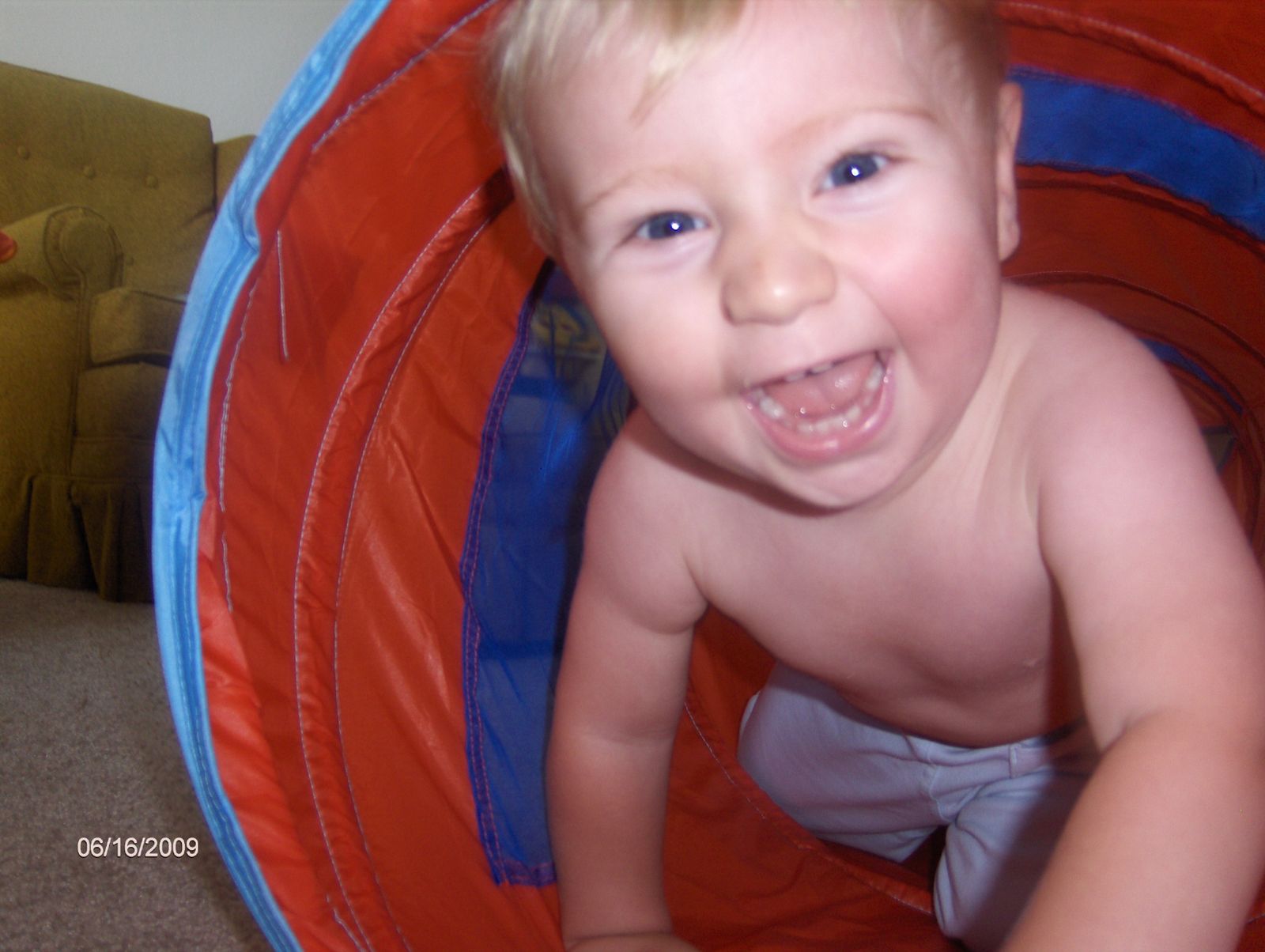 Play Tunnels
Price: Varies $20 - $40
Size: Large
Age: Crawling+ (Manufacturer recommends 3yrs+)
Durability: Medium
Pros: Can be used indoors and outdoors. Helps promote active play. Flexible and easily positionable. Stores easily in smaller form.
Cons: Spring form can lose shape if used too roughly. In less-rugged brands, metal ends of spring can break through fabric and pose a scratching risk. (I recommend the brand I have pictured and linked to, as it has held up well despite rough use by older children, though the coils are not fully round.)
 Educational Value: Promotes gross motor skills. Helps child learn to recognize perspective variances, e.g. Mommy can't see me, but I can see her!
Pretend Food: Fruits and Veggies (Melissa & Doug)

Price: $20/set
Size: Medium (set)
Age: 18 months+
Durability: High
Pros: Familiarizes kids with foods. They can play with the fake stuff rather than the stuff you want them to eat. The Melissa and Doug brand foods are much more durable than most pretend foods and look more realistic in size. They also feel very similar in texture to the foods they copy. All pieces are large enough not to be choking hazards.
Educational Value: Great for initiating pretend play in a way your child can understand. She can cook for you, feed you, show you how she likes to eat her corn, and clean up afterward. Helps develop imagination while subtly promoting healthy food choices!
 Knob Puzzles
Educational Value: Great for initiating pretend play in a way your child can understand. She can cook for you, feed you, show you how she likes to eat her corn, and clean up afterward. Helps develop imagination while subtly promoting healthy food choices!
 Knob Puzzles
Price: $10
Size: Medium
Age: 12 months+
Durability: Very High
Pros: This particular puzzle pictured (by Melissa & Doug) is one that I have. I have seen this same puzzle in the house of every other toddler my son's age. It's that great a puzzle. It's made of hard wood, it only has 5 pieces. The backgrounds behind each piece exactly match the piece. Each piece can be fitted into its proper spot in more than one orientation, so the child feels more success. Big wooden knobs on top help the child to control the piece.
Cons: Not easily stored. There are puzzle storage racks available, but many already come with puzzles of their own or do not accommodate so large a puzzle, particular with the knobs on top. The pieces are also rather painful when your child throws them at you.
Educational Value: Develops fine motor skills. Helps children learn to sort by shapes and colors. Promotes focus and concentration on a task.
Wednesday, May 12, 2010
Toy Review: Toys for the Second Year
Around the end of the first year or shortly after the start of the second year (i.e. around the first birthday), most children begin walking. My son wasn't necessarily a prodigy for beginning to walk unassisted at 9 months, nor is any child necessarily deficient for delaying this ability until 15 months. As children grow and develop, their interests become apparent, and depending on the environments they have experienced and the activities that have captured their foci, different skillsets will appear at different times. Generally, girls will speak earlier and boys will walk sooner, but there is so much variation here (and over so few months of time is it relevant) that if the roles are reversed there is really nothing abnormal about it. I did notice in Jackson and many of his friends that a MAJOR mental growth spurt was readily apparent right around the first birthday. Coincidentally, it was also not until that same span of time until I was even remotely convinced that I might be willing to go through the effort of spawning another human.
So, now that the child is ambulatory and at the early stages of verbal development, as well as having some more neurons firing in her brain, it's time to find something suitable for new forms of play. After all, a cardboard box and a plastic bottle no longer seem to satisfy her, so to keep her from fishing around in your computer desk for paper clips to gag on, you need to get more creative. After all, it's far cheaper to buy toys than pay an ER bill.
There are many toys geared toward the 12 months+ crowd. Many of them are riding toys or musical toys. In fact, many of the toys I profiled for the first year are still rather relevant, only now instead of gumming them with teething mouths full of drool, your little darling can start to try some of the uses for which the toys were intended.
The American Academy of Pediatrics recommends the following toys for the Second Year:
- Board books with large pictures, simple stories
- Books and magazines with photographs of babies
- Blocks
- Nesting toys
- Simple shape sorters and pegboards
- Beginner's jigsaw puzzles
- Toys that encourage make-believe play (child lawn mower, kitchen sets, brooms)
- Digging toys (bucket, shovel, rake)
- Dolls of all sizes
- Cars, trucks, trains
- Unbreakable containers of all shapes and sizes
- Bath toys (boats, containers, floating squeak toys)
- Balls of all shapes and sizes
- Push and pull toys
- Outdoor toys (slides, swings, sandbox)
- Beginner's tricycle
- Connecting toys (links, large stringing beads, S-shapes)
- Stuffed animals
- Child keyboard and other musical instruments
- Large crayons
- Toy telephone
- Unbreakable mirrors of all sizes
- Dress-up clothes
- Wooden spoons, old magazines, baskets, cardboard boxes and tubes, other similar safe, unbreakable items she "finds" around the house (i.e. pots and pans)
[Citation]
I agree with much of what is on this list and would also like to point at that there is NO MENTION at all that children should have toys that make electronic sounds or music or have any sort of graphical display. It's not that it's strictly a bad thing to have those kinds of toys or that your child will not enjoy them. The problem is that they often teach the wrong lesson: Children need to learn causal relationships. If you give a child an electronic keyboard that makes noises not correlated to the action, the child fails to learn how sounds are made. However if you give a child a piano that plays notes when he pushes the keys, then the connection can be made that the act of depressing the key causes a sound to be made. Remember: toys are the learning tools you give to your child to teach him about the world. This is his first education, and no matter how much YOU know, HE is still unaware of the fundamental laws of the universe.
Check out some toy suggestions next week! :)
Toy Review: Toys for the Third Year
One of the greatest joys of the third year is the sudden increase in verbal skills. Kids start yammering away with words you might be surprised they know how to use. They'll quote movies and songs and familiar phrases used by those around them. (A personal recent favorite was Jackson's shouts of "Fire in the hole!" as he repeatedly defecated in the bathtub, post-bath. Classy, eh?)
More fun still, however, she'll be developing her ability to pretend in play. This faculty begins to gain some small strength in the second year, but by the third year pretend play becomes more important. Over a gradual period or even perhaps overnight, she will begin to mimic behaviors familiar to her, trying activities that she is used to seeing others do. Perhaps she will pretend to vacuum or sweep or do dishes. She might pretend to drive or care for a baby. And if you encourage this behavior, not only are you taking part in her play, which makes your child very happy, but you are helping to stimulate her mental growth.
For example, if the child has fake food toys that he likes to feign to eat, you can help him expand the imaginative play. Maybe you set up a fake restaurant area. One region is the "kitchen", another is the "dining area", and he has to cook and serve the food. You can help him add seasoning or adjust the cooking temperature. Perhaps he has chosen some rather unique food combinations: "Oh, I've never had onions with my bananas before!" You might also show him how to set a table or hold a pan so he doesn't get burned. Meanwhile, he learns about the experience of cooking and proper dining behaviors as well as improving his gross and fine motor skills--with the added bonus that he is spending time with one of his absolute most favorite people of all time.
The third year focuses a great deal on skill refinement as well. Her crayon drawings on your furniture will be more accurate with their circles. When she knocks her stack of blocks off the table onto your toes, you can bet it was a much higher stack than she used to be able to make; and just look at how much farther those pieces can fly!
Interestingly, the American Academy of Pediatrics does not include a list of toys appropriate to the third year of life in its hallmark volume for parents: Caring for Your Baby and Young Child: Birth to Age Five. While it may or may not be present in the Fifth Edition, this is not explicitly indicated in the penultimate "revised" edition, which is the version I have and use. Instead there is a box detailing ways to help develop your child's burgeoning intellect.
For some more ideas on how to help your child develop his natural drive to learn and improve, check out this list provided in the AAP book (referenced in the paragraph above) on page 330. To save on space, I have only transcribed the first sentence of most of the bullet points:
Next week, I'll begin showcasing some of the toys that I've found to be great for the third year. See you next Wednesday!
More fun still, however, she'll be developing her ability to pretend in play. This faculty begins to gain some small strength in the second year, but by the third year pretend play becomes more important. Over a gradual period or even perhaps overnight, she will begin to mimic behaviors familiar to her, trying activities that she is used to seeing others do. Perhaps she will pretend to vacuum or sweep or do dishes. She might pretend to drive or care for a baby. And if you encourage this behavior, not only are you taking part in her play, which makes your child very happy, but you are helping to stimulate her mental growth.
For example, if the child has fake food toys that he likes to feign to eat, you can help him expand the imaginative play. Maybe you set up a fake restaurant area. One region is the "kitchen", another is the "dining area", and he has to cook and serve the food. You can help him add seasoning or adjust the cooking temperature. Perhaps he has chosen some rather unique food combinations: "Oh, I've never had onions with my bananas before!" You might also show him how to set a table or hold a pan so he doesn't get burned. Meanwhile, he learns about the experience of cooking and proper dining behaviors as well as improving his gross and fine motor skills--with the added bonus that he is spending time with one of his absolute most favorite people of all time.
The third year focuses a great deal on skill refinement as well. Her crayon drawings on your furniture will be more accurate with their circles. When she knocks her stack of blocks off the table onto your toes, you can bet it was a much higher stack than she used to be able to make; and just look at how much farther those pieces can fly!
Interestingly, the American Academy of Pediatrics does not include a list of toys appropriate to the third year of life in its hallmark volume for parents: Caring for Your Baby and Young Child: Birth to Age Five. While it may or may not be present in the Fifth Edition, this is not explicitly indicated in the penultimate "revised" edition, which is the version I have and use. Instead there is a box detailing ways to help develop your child's burgeoning intellect.
For some more ideas on how to help your child develop his natural drive to learn and improve, check out this list provided in the AAP book (referenced in the paragraph above) on page 330. To save on space, I have only transcribed the first sentence of most of the bullet points:
- Encourage creative play, building, and drawing. Provide the time and tools for playful learning.
- Be attentive to your child's rhythms and moods.
- Give consistent warm, physical contact--hugging, skin-to-skin, body-to-body contact--to establish your child's sense of security and well-being.
- Talk to or sing to your child during dressing, bathing, feeding, playing, walking, and driving, using adult talk.
- Read to your child every day.
- If you speak a foreign language, use it at home.
- Introduce your child to musical instruments.
- Play calm and melodic music for your child.
- Listen to and answer your child's questions.
- Spend one-on-one personal time with your child each day.
- Offer your child simple choices in appropriate situations throughout the day.
- Help your child use words to describe emotions and to express feelings such as happiness, joy, anger, and fear.
- Limit your child's television viewing and video time; avoid violent cartoons.
- Promote out-of-home social experience such as preschool programs and playgroups in which your child can play and interact with other children.
- Acknowledge desirable behaviors frequently.
- Make sure other people who provide care and supervision for your child understand the importance of forming a loving and comforting relationship with her.
- Spend time on the floor playing with your child every day.
- Choose quality child care that is affectionate, responsive, educational, and safe; visit your child care provider frequently and share your ideas about positive caregiving.
Next week, I'll begin showcasing some of the toys that I've found to be great for the third year. See you next Wednesday!
Saturday, April 24, 2010
First Year Toy Review, Part II
(This post was originally scheduled for April 7, 2010, but I've been having trouble getting my camera to upload photos and kept delaying it. In the end, I've just decided that you'll have to use your own imagination for a couple of these. Hope you can handle it!)
Last week, I profiled a few toys that I had acquired for my son when he was just learning to sit upright. While it may seem a little backwards, I'm going to cover some toys today that do not require the ability to sit unassisted. These are toys that a baby can play with during the first year of life at any point, so they are also all good toys for infants in general who are confined to a seat.
Last week, I profiled a few toys that I had acquired for my son when he was just learning to sit upright. While it may seem a little backwards, I'm going to cover some toys today that do not require the ability to sit unassisted. These are toys that a baby can play with during the first year of life at any point, so they are also all good toys for infants in general who are confined to a seat.
________________________
Plastic juice bottle with jingle bells
Price: $2
Size: Small/Medium
Age: 4 months+
Durability: Variable
How it's made: This is a toy you make yourself. Ideally speaking, to create this you would buy (or reuse) some small jingle bells from your local craft store. Put 4 or so into a plastic bottle (preferably Simply Orange, as they use very durable plastic, and OJ is easy to rinse out) and recap. Be sure the cap is on very snugly or use a small amount of superglue to be extra sure the cap will not come off. If you use glue, use your common sense as well: don't overglue so that it drips below the cap; don't let the child come into contact with the glue.
Pros: It's cheap and easy and VERY entertaining. Also, if you lose it, it's easily replaced the next time you empty a bottle of orange juice.
Cons: Kids may fight over who gets to play with it. Guests may mistake it for trash. Can be fairly loud.
Educational Value: There's nothing really easily described about the educational value of a large rattle like this, but I still maintain that a baby learns from playing with it. A child's environment is his first teacher, so this is probably one of his first physics professors. Primarily, the value in this toy is that it allows kids an opportunity to experiment with physical consequences in a fairly safe environment. "When I turn it this way, these things in the middle move over here! And they make noise when they move! Whee!"
________________________
Plastic water bottle, half-scrunched and recapped
Price: $0
Size: Small
Age: 4 months+
Durability: High
How it's made: When you finish a bottle of water, remove the label. Uncap, squeeze about half the air out, and recap tightly. (Be sure that the region near the cap isn't warped so that the cap does not fit properly!) Glue the cap shut as in the above toy, if desired. Some parents like to leave the bottle unscrunched or with some water in it or both. You can try out multiple variations to see which your child prefers.
Pros: This toy is easy to make instantaneously. You can create it anywhere you are, so long as you have a bottle of water with you. GREAT teething toy. When scrunched, the plastic makes fun noises that correspond to your baby's actions. The reflections and remaining water/water droplets inside capture an infant's eye. It's lightweight and fits well in a baby's hand. And of course, it's ridiculously cheap. If you suspect signs of wear or it gets too dirty, you can just toss it in the recycle bin and make a new one.
Cons: Guests may think it's trash.
________________________
Links

Price: Varies, Under $10
Size: Very small
Age: Birth+
Durability: High
Pros: You can do soooo many things with links. You can use them to hold toys in cars (suspended from OSHs or infant carrier handles), strollers (hooked to frame), chairs in restaurants, etc. You can use them as pacifier clips. You can connect two toys together to make a new toy. The kid can chew on them as toys in their own right. Most links come in a variety of colors, textures, and even shapes. They can be used for parent toys, as well, for clipping cell phones, keys, or water bottles (w/carabiners) to diaper bags, purses, or belt loops.
Cons: Many brands of links lose their strength after a couple of years of hard use. They will not always stretch around what you hope they will.
Wednesday, March 31, 2010
First Year Toy Review, Part I
My husband Andrew has a great mindset that he has shared with me about making purchases: When you buy something, think about the day you will one day have to dispose of it. Children are not babies for very long, though it may seem like it at the time. Because I am keen on helping my family save money, I try to purchase toys with high standards of quality that will last a long while. Because my son is Herculean, I try to ensure that all of his toys are built to withstand something akin to a nuclear blast. And because I recognize that children are in a continual state of development, I try to find toys that will grow and develop with Jackson, rather than be discarded as "too young" before the purchase price of the toy has been validated.
The toys I am highlighting today are ones that I bought for my son when he was 5 or 6 months old. He is now 27 months old, but we still find time to play with some of them. What I like about each of these toys in particular is that they have many developmental stages of play for a child.

Price: $10
Size: Small/Medium
Age: 5 months+
Durability: Medium-High
Pros: The simplicity of this toy is what makes it great for babies. They can actually hold the individual rings; they can chew on the support stand; it's "rockable" so it doesn't tip over too easily when an uncoordinated tot bumps it accidentally. They also have modified the top ring so that instead of being strictly a hollow, red donut, it functions as a semi-clear, semi-opaque red rattle.
Cons: The tower of the stack can fit into a child's mouth up to a point. If you have a child with a particular large mouth, she may be able to hit her gag reflex, though I haven't yet seen this become a problem. The tower and stack can be used as a hammer, so your little Bam-Bam may reek havoc on your toes as you walk past.
Educational Value: Standard colors make it easy to identify color names to your child. Helps teach order of operations for stacking, since the base is wider than the top and limits how the rings can be stacked. Helps develop fine motor skills for placing the rings on the stack.
_________________________

Price: $13
Size: Small/Medium
Age: 5 months+
Durability: High
Pros: There are numerous parts to this, but not so many that a parent can't keep track of them. The toy is a container and is designed to help children put the blocks through the right shape hole. Who doesn't love a toy that encourages kids to be neat? The blocks themselves are very durable and are well-designed to avoid injury: All edges are smooth; the pieces are VERY well structured so that babies can chew on them and slobber on them and not bust them, plus they can hit them on anything without making even a dent. While each shape is hollow, there is a vent hole in the center to prevent the child from accidentally gaining suction and getting the toy stuck on any body part. The pieces all fit easily within the container, which has a convenient carrying handle. The yellow lid is a great attractant (and may be the only part the child wants to play with for a long time), too!
Cons: This is really nit-picky, I know, but one of the shapes is really hard to name. When I play with my son, I like to be able to identify the shape, color, texture, etc. The triangle, star, circle, and square are fairly simple. But the fifth shape could be called a plus, an X, a cross, or whatever other name you might imagine for that shape. Ideally speaking, anyone who plays with this toy with your child will be in agreement as to what shape-name to associate to that piece.
Educational Value: This toy is great for helping a baby learn basic colors and shapes. Each shape will only fit into its own shape hole in one particular orientation, so there's no cheating there. Believe it or not, it's a tough concept for a baby to learn that convex and concave shapes can match one another. (Think about it: you wouldn't give a 4-month-old a puzzle.) Each shape comes with a matching piece that is the same shape and color, so you could help teach matching skills as well. The hole in the middle of each shape matches the exterior shape (e.g. the star shape has a star hole) to help parents and caregivers guide children to learn how to sort shapes.
_________________________

Price: $10
Size: Small
Age: 4 months+
Durability: Very high
Pros: This is the most cleverly constructed simple toy I have ever encountered. The Stack & Roll Cups have been a favorite not just with my son and his compatriots in babyhood but also with parents. They are that awesome. Like the old school stacking cups (which I also recommend but am not profiling today), these can stack on top of one another into a tower. They also nest well within one another. But what the normal stacking cups can't do, but these can is to join together to make balls. Each cup has a hole in the end that is about an inch in diameter, and the smaller ones have extra ventilation holes, "just in case". There are 10 cups in all, which can make 5 balls simultaneously, but each "cup" can form a ball with both the next cup larger and the next cup lower. AND you can stack any smaller cup on the back of any larger cup. As if that weren't enough, they included another little ball with a smiley face and a jingle bell inside. (For a while, it seemed like the jingle ball was enough for Jackson and friends while us parents and other adults played with the cups. They really are fun!) Kids can smack them around, fit them together, stack them, and roll them around as balls or even bring them in the bathtub. The favorite, of course, is to stick the jingle ball inside a ball made from the cups and set your child loose chasing it, fingering the ball inside, and shaking it around. WAIT! There's more! I've saved the best for last! Not only can your runt gnaw on these things (and get great little cup-shaped red marks on her face), but they store up really compactly. Because of the way the jingle ball fits into any of the cup-balls, and the way that any cup can form a ball with the next larger and next small size, you can make one big nested ball out of all the pieces. This whole set can be stored neatly together in an area the size of the two largest cups forming a ball.
Cons: The sophistication of the toy is lost on babies. Also, because there are 10 cups, the manufacturers had to use more than the standard set of readily name-able colors, so there can be some awkward moments as you try to encourage your baby to chase down the "ummm...yellow-green cup".
Educational Value: Each of the standard rainbow colors is represented in a cup, plus a couple of extras to show that not all color names are so clearcut. The colors are also ranked in size by rainbow order with the smallest cups being in the purple portion of the spectrum and the largest being red. The cups have numbers on them, as well, concatenating the order in which the cups will stack as a whole. (Of course you could also make a stack with all evens and another with all odds. Or you could nest the evens and nest the odds. Or....) When you make the cups into the 5 simultaneous balls, other patterns are apparent: each in the pair of cups forming it has the same shape (e.g. a star) engraved in a ring on it; each in the pair are of the same or nearest color name (though the red and orange ball gets a bit awkward to explain). There are soooo many educational opportunities with this toy that even through much of elementary school it can be a useful demonstrative tool.
_________________________
That's all for today, folks. I've got lots more to review, but I'm tired. I promise they are not all Fisher-Price toys! It just so happens that Fisher-Price has some high quality toys for children for the first year. Playskool and other brands dominated the ranks for many of our toys for the second year, which I'll get around to profiling when I finish up with first year toys. Stay tuned for more baby toy fun!
Wednesday, March 24, 2010
Toy Review: Toys for the First Year
Many parents, grandparents, aunts, uncles, older siblings, friends, and guilty-conscience acquaintances want to buy toys for children but have NO IDEA what to get them. At some point, we've all been that person shopping for the kid whom we rarely see and have little to no idea what she'd want for a toy. When the child is a baby, finding the "right toy" can seem even less clear-cut for some people. So, what I've decided the world (heh, I flatter myself) needs is some idea of what to get for children of different ages, based on my experience with my own son and other children in his general age group.
When you plan to purchase a toy for a child, the first consideration needs to be: is the parent going to be happy with this toy? Maybe the toy is a gigantic Tonka truck for your newborn (yes, my MOM did that to me); maybe it's a robotic dinosaur that roars (and terrifies your 2-year-old). In these situations, the toys are not unwanted in and of themselves, but they are really age-inappropriate.
Of course, the gift might be something that is categorized as being for a child's first year and have so many bells and whistles that it annoys the crud out of anyone who is sane enough to like a bit of quiet (including the child). Maybe it's visually overstimulating to the point where your child just avoids it (like this Discovery Elephant from Infantino).
Other considerations are the child's capability to play with the toy and what the child is likely to do with it. Most babies can't even hold things with their hands for about the first 3 months, so anything they use for entertainment before that has to be automatic or parent-controlled. Also, for the first year and often beyond, pretty much anything the child holds has the same destination: the mouth. If you suspect lead paint, barium paint, small parts, sharp edges, easily broken bits, or any other method by which a child could get hurt by breaking something or putting it in his mouth (such as choking!), then DO NOT give it to a child who hasn't reached the 12 month mark yet. Ideally speaking, a child under age 3 years should have NO ACCESS to anything that is dangerous, including pen caps, loose change, Legos, and Barbie shoes.
Also, believe it or not, expensive does not mean good. Yes, generally speaking, higher quality children's products do have a higher price. However, just because you spend $80 on a rocking giraffe, do not expect that the child will necessarily get $80 worth of enjoyment out of it.
When it comes to toys for the first year, simple is ideal. Most children under 12 months are happy most of the time with a half-crumpled water bottle to squeeze and chew. Aim for that mentality. In fact, for the first year there is very little need for toys at all except as a distraction technique. Babies will play with whatever surrounds them in their environment. Give a baby a solid wood drink coaster with concentric grooves in it, and she will chew on it, bang it on furniture, and touch its various textures. To give a child this age a toy that plays 50 digital songs and "teaches" a foreign language that the parents do not speak is overkill--and runs a serious risk of overstimulation.
Overstimulation is the technical term to describe a lot of seemingly different behaviors in young children. An overstimulated child will tend to be crankier and more withdrawn. If a child experiences too much overstimulation (such as excessive television and movies and video games), she will eventually come to expect the world to entertain her instead of finding her own entertainment. A baby is seldom troubled with the feeling of boredom. Everything in life is new and exciting (like that electrical outlet you forgot was under that table and that fork that went missing recently), and the most interesting things to a baby are those that help the child learn about the world she has joined.
The American Academy of Pediatrics has some great guidelines for parents on age-appropriate toys and activities:
One- to Three-Month-Old
- Images or books with high-contrast patterns
- Bright, varied mobile
- Unbreakable mirror attached to inside of crib
- Rattles
- Singing to your baby
- Playing varied music from music boxes, CDs, records, or tapes (and I'll add in mp3s here)
Four- to Seven-Month Old
- Unbreakable mirror attached to inside of crib or playpen
- Soft balls, including some that make soft, pleasant sounds
- Textured toys that make sounds
- Toys that have fingerholds
- Musical toys, such as bells, maracas, tambourines (Make sure none of the parts can become loose.)
- See-through rattles that show the pieces making the noise
- Old magazines with bright pictures for you to show her
- Baby books with board, cloth, or vinyl pages
Eight- To Twelve-Month-Old
- Stacking toys in different sizes, shapes, colors
- Cups, pails, and other unbreakable containers
- Unbreakable mirrors of various sizes
- Bath toys that float, squirt, or hold water
- Large building blocks
- "Busy boxes" that push, open, squeak, and move
- Squeeze toys
- Large dolls and puppets
- Cars, trucks, and other vehicle toys made of flexible plastic, with no sharp edges or removable parts
- Balls of all sizes (but not small enough to fit in the mouth)
- Cardboard books with large pictures
- CDs, tapes, music boxes, and musical toys
- Push-pull toys
- Toy telephones
- Paper tubes, empty boxes, old magazines, egg cartons, empty plastic soda/juice/milk bottles (well rinsed)
[All the above bulleted data was pulled directly from Caring for Your Baby and Young Child, Birth to Age 5, Revised Edition (link goes to 5th Edition, newer than my copy) which is a publication put out by the American Academy of Pediatrics. This book can be obtained free of its $20 price tag by joining the Publix Baby Club, which sends you a free copy just for joining.]
You'll notice that nowhere in all of that was a recommendation that you overload a child with glamorous, flashy toys. Many people have remarked that if you give a child a toy, he will spend a greater amount of time playing with the box it came in. Save yourself the money and just give the kid the box!
Over the next couple of weeks, I'll highlight some toys that have proven to be good all-around buys. I am not affiliated in any way with toy manufacturers or distributors, so I'm completely unbiased (and unfunded, heh). All toys that I will include for recommendations for the first year are durable and will easily tolerate a slobbery, strong, teething baby and "survive" with barely any signs of wear.
Wednesday, March 17, 2010
Stay-at-home parenting, Part 2
Many people wonder: what do "stay-at-home" parents DO all day? (Some people also like to refer to the practice as "work-at-home" parents, which is excessively vague and confusing, methinks.) For one, I'm rarely home! About 3 or 4 mornings a week, Jackson visits the gym's Kid's Club while I get my exercise or physical therapy time. In the early days when I started taking him to the gym, I would just relax in the hot tub and try to melt away the pain and stress of never having down time. I progressed over time to where I was regularly attending Zumba class and then added in more weight-bearing exercise. Jackson, unawares, merely enjoys time with children in a variety of age groups.
We go to parks a great deal and explore the variety of playgrounds and parks available here in Gainesville, FL. We visit other families with young children and have playdates. On days when we'd rather not be outside, we go to the play area at the local shopping mall or the natural history museum, which has free admission and is well-geared toward children. We have picnics together for our lunches after the gym, sometimes joined by friends. He has also just started a new gymnastics class and has regularly attended a weekly open-play event at a local play-place for kids. (http://www.suncountrygymnastics.com/) We have regularly attended as a fun activity for a Friday morning that gets us around other parents and young children as well as exercise in an environment where Jackson can fairly safely play however he likes.
Jackson is also learning the basics of household management. He likes to pretend to vacuum and has learned most of the ins and outs of vacuum usage, though so far he's too scared to operate it himself. He loves to sweep with brooms and dustpans. He loves to pretend to cook at his kitchenette, custom-built by my step-dad. (Ric is available to build and ship custom-made all-wood kitchenettes and toys: reraddas (at) gmail (dot) com; the man is an awesomely talented journeyman carpenter!)
Jackson knows a good bit of geography, too, so he can often tell me how to get where he wants around town on the days when it's not too pressing that I go where I intend. He likes to walk around the mall, feed the ducks at the pond by the hospital, play with the display toys at Toys R us and Target, and will point out (and demand to visit) when we are passing the home of a good friend of his. Because so much of his life is decided for him, I try to allow him a certain amount of autonomous decision-making. But of course, there are boundaries in all things: we do not go to the playground if it is time for lunch or too close to naptime. We do not watch a movie while after he has his bath and is calming down for bedtime.
At this point, our day is well-regimented. We wake each weekday morning, eat breakfast, and go somewhere by 9 or 9:30. Typically around 10:45 or 11 we're starting our lunch. Afterward, we have some low-key play, brush teeth together, read a story, and Jackson naps at around noon. When the world isn't conspiring against us, 2.5 to 3 hours later Jackson comes out of his room with a big smile and tackles me with a hug and a kiss and tells me he loves me. We spend a little time playing or cuddling while he adjusts to being awake again, then we have a snack. Afterward we typically either go outside to play or run errands or both, if time allows. Andrew gets off work around 5:30pm or 6:pm most days, so we do dinner then as a family. Jackson usually finishes eating first, excuses himself from the table with an "All done!" and plays independently while Andrew tells me in a burst of excitement all about his day. The two of them then go do bath time while I clean up the dishes. Shortly after I finish, Jackson comes tearing out of the bathroom, naked but for his lion towel (which makes him feel like a king). We try to wrangle him into a diaper and some pajamas before he gives us reason to use our Bissell Spot Bot. He gets a little more quiet play time, then we brush teeth and floss as a family. Andrew reads him what seems an interminable number of books while I listen through the baby monitor, then Jackson goes to bed. There's very little different on the weekends, especially since Andrew is still finishing up some college courses to prepare for graduate school.
I'm planning some more posts in the future that will talk about some of the toys and games that we highly recommend, so stay tuned!
Subscribe to:
Posts (Atom)